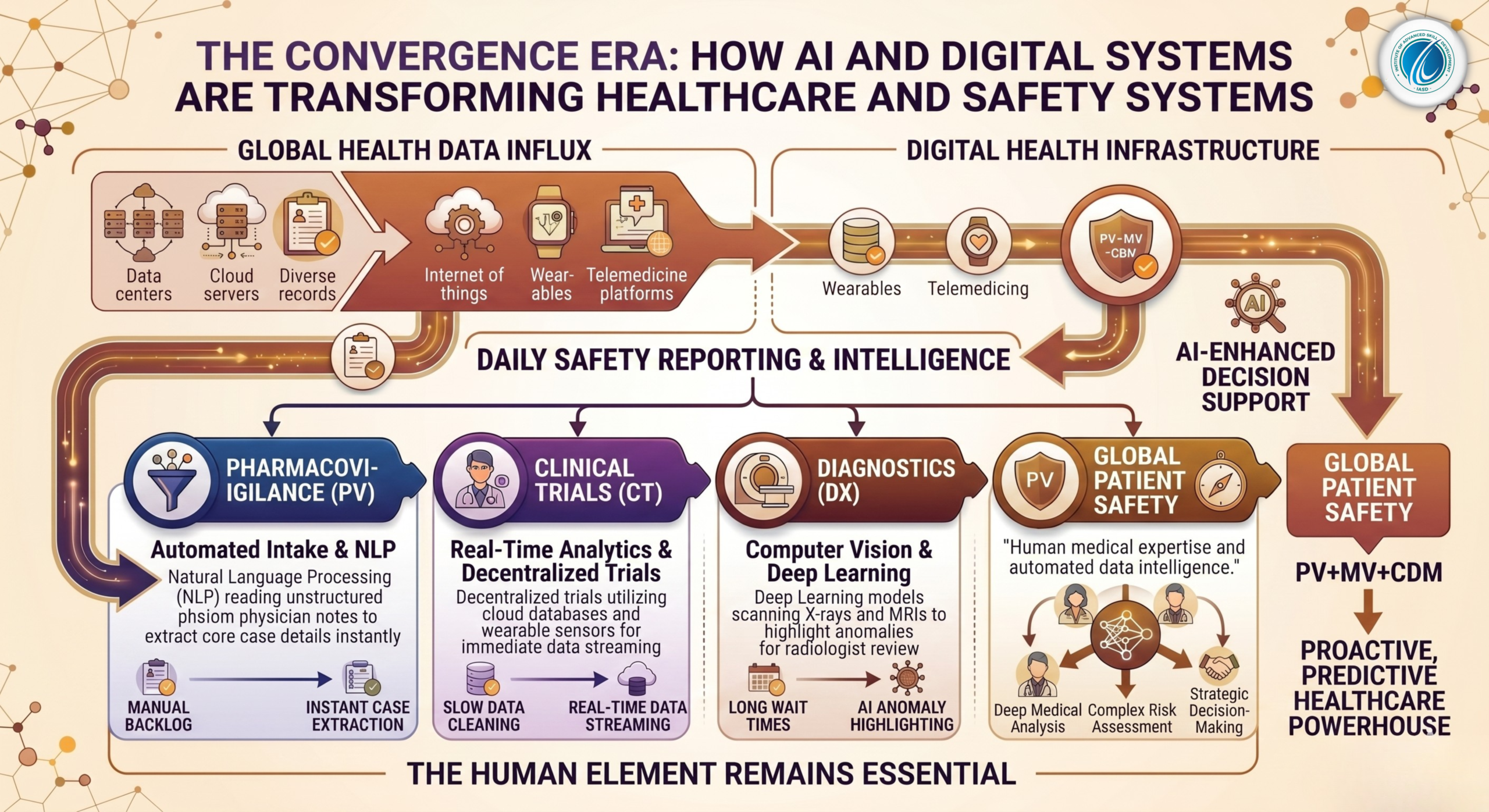
The life sciences sector is experiencing a historic shift. The massive influx of global health data, coupled with the rapid rise of digital health infrastructure, has created a challenge: human teams alone cannot keep up with the scale of information. Today, the integration of Artificial Intelligence (AI) and advanced cloud computing is no longer a luxury—it is a necessity.
“The true future of healthcare lies at the intersection of human medical expertise and automated data intelligence.”
Where Innovation Meets Execution
| Discipline | Traditional Challenge | AI/Digital Transformation |
| Pharmacovigilance | Massive volumes of incoming ICSRs causing manual backlogs. | Automated Intake: Natural Language Processing (NLP) reading unstructured physician notes to extract core case details instantly. |
| Clinical Trials | High patient drop-out rates and slow data cleaning cycles. | Real-Time Analytics: Decentralized trials utilizing cloud databases and wearable sensors for immediate data streaming. |
| Diagnostics | Long wait times for medical imaging interpretation. | Computer Vision: Deep learning models scanning X-rays and MRIs to highlight anomalies for radiologist review. |
The Human Element Remains Essential
While algorithms can cross-reference data in milliseconds and flag safety signals at incredible speeds, they lack clinical judgment. AI does not replace the registered pharmacist, the data manager, or the drug safety associate. Instead, it automates repetitive tasks—like initial data entry or routine query generation—freeing up skilled professionals to focus on deep medical analysis, complex risk assessment, and strategic decision-making.
By embracing these digital frameworks, the life sciences industry is evolving from a reactive model to a proactive, predictive powerhouse for global patient safety.