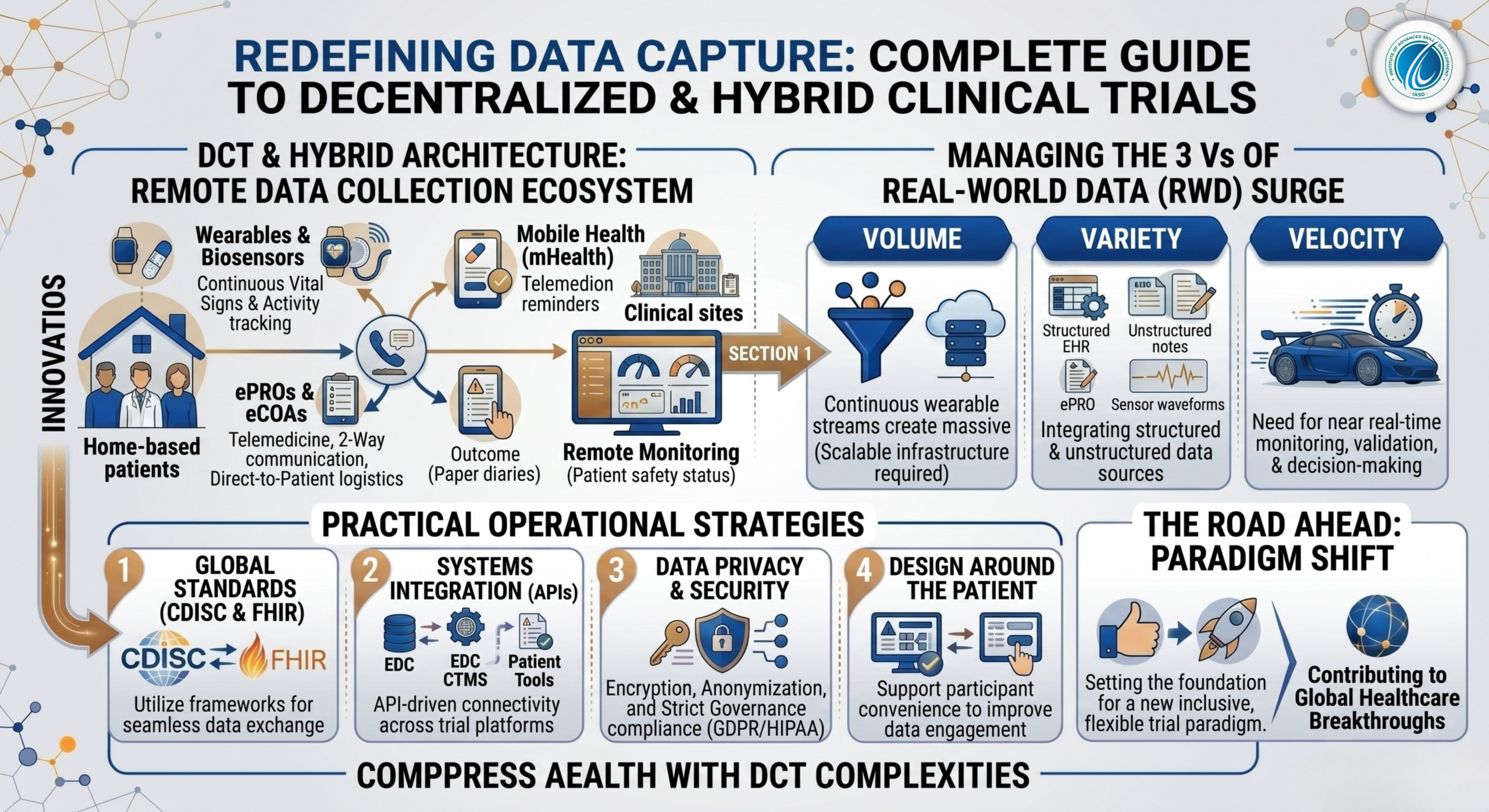
The global clinical research infrastructure is undergoing its most significant structural shift since the introduction of electronic data capture. For decades, the execution of a clinical trial was strictly centered around the physical site—requiring patients to travel frequently to centralized academic medical centers to undergo diagnostic laboratory monitoring, complete symptom diaries, and receive study medications.
However, this site-centric approach creates significant hurdles, leading to slow patient recruitment, high drop-out rates, and limited diversity within study populations.
To overcome these limitations, the industry is embracing Decentralized Clinical Trials (DCTs) and hybrid execution models. By shifting the focus of research directly to the patient’s home, DCTs are completely redefining how clinical data is captured, managed, and validated.
1. The Architecture of Decentralized and Hybrid Trials
1.1 What are DCTs and Hybrid Models?
A Decentralized Clinical Trial (DCT) is a trial model where study-related activities are conducted entirely or partially away from traditional, centralized clinical trial sites. A Hybrid Model combines remote, home-based data collection with targeted, necessary visits to local community clinics or regional diagnostic centers.
1.2 The Digital Technology Stack Driving Remote Data Capture
Decentralized research models replace face-to-face site check-ins with an integrated stack of modern healthcare technologies:
-
Medical Wearables and Biosensors: Continuous, non-invasive digital tools that track vital signs (such as continuous blood glucose, heart rate variability, oxygen saturation, and sleep cycles) in real-time within a patient’s natural environment.
-
ePROs and eCOAs (Electronic Patient-Reported Outcomes): Specialized mobile applications that prompt patients to log symptom scores, pain indices, and quality-of-life metrics directly on smartphones, eliminating the data entry errors common to old paper diaries.
-
Telemedicine Platforms: Secure, compliant video communication channels that enable investigators to perform virtual clinical evaluations and monitor patient safety remotely.
-
Direct-to-Patient (DtP) Logistics: Validated supply networks that ship temperature-controlled investigational medicinal products (IMPs) directly to the patient’s residence, supported by home-health nursing networks.
2. Managing the Surge of Real-World Data: The 3 Vs Challenge
While decentralized technologies make participation easier for patients, they create major data management challenges behind the scenes. Clinical Data Management (CDM) teams must handle a massive influx of Real-World Data (RWD) characterized by the classic big data paradigm: Volume, Variety, and Velocity.
                           ┌───────────────────────────┐
                           │      VOLUME (Scale)       │
                           │ Continuous data streams   │
                           │ require scalable clouds   │
                           └─────────────┬─────────────┘
                                         │
                                         ▼
┌───────────────────────────┐            │            ┌───────────────────────────┐
│     VARIETY (Diversity)   │ ───────────┼───────────>│     VELOCITY (Speed)      │
│ Structured EHR, ePRO, and │            │            │ Near real-time streams    │
│ unstructured sensor files │            │            │ require automated reviews │
└───────────────────────────┘            │            └───────────────────────────┘
                                         ▼
                           ┌───────────────────────────┐
                           │   CLEAN REGULATORY DATA   │
                           └───────────────────────────┘
2.1 Volume: Scaling System Storage
Instead of capturing single, static vital sign measurements during once-a-month clinic visits, a medical wearable can stream data points every few seconds. This creates massive datasets per patient, requiring CDM infrastructures to transition away from traditional relational databases and toward scalable, cloud-based big data warehouses.
2.2 Variety: Integrating Disparate Data Formats
Data arrives at the data management hub from many different sources and formats: structured demographic logs from electronic medical records (EHRs), text-based symptom entries from mobile health apps, and raw binary sensor outputs from physical patches. Standardizing these diverse formats into a unified dataset requires advanced data integration programming.
2.3 Velocity: Managing Real-Time Data Streams
The speed at which data streams enter clinical systems demands real-time oversight. Data managers can no longer wait until the end of a study month to clean incoming data. Instead, they must deploy automated cleaning scripts and AI-driven dashboards to review, validate, and verify data continuously, ensuring patient safety is maintained throughout the trial.
3. Practical Operational Strategies for Success
Successfully executing a decentralized clinical trial requires moving past technological novelties and focusing on operational interoperability, security, and patient compliance.
3.1 Adopting Global Interoperability Standards (CDISC and FHIR)
To ensure that external data streams can easily talk to central Electronic Data Capture platforms, systems must use global data exchange frameworks. This means enforcing CDISC SDTM (Study Data Tabulation Model) standards for trial data, and utilizing HL7 FHIR (Fast Healthcare Interoperability Resources) application programming interfaces (APIs) to securely pull data from real-world hospital Electronic Health Records.
3.2 Implementing Strict Privacy and Security Frameworks
Remote data streaming opens up potential data privacy vulnerabilities. DCT data workflows must embed robust compliance measures, including:
-
End-to-end encryption for data both at rest and in transit across networks.
-
Strict Data Anonymization and Tokenization protocols, ensuring patient identities are hidden from central database analysts.
-
Comprehensive, blockchain-backed or immutable audit trails that log every data point’s origin, fulfilling global privacy mandates like GDPR and HIPAA.
3.3 Prioritizing Patient-Centric Design to Reduce Burden
Technology should support the patient, not overwhelm them. If a hybrid trial requires an elderly participant to navigate multiple confusing phone apps, remember complex charging schedules for sensors, and manually upload log files daily, compliance will drop quickly.
Data teams must prioritize user-friendly app designs, unified single-sign-on access, and automated data syncing to ensure complete, high-quality data capture.
4. The Future Horizon for Data Managers
Decentralized and hybrid trial models are not a temporary industry trend; they represent the permanent evolution of international clinical research.
For sponsors and Contract Research Organizations, success requires balancing technical innovation with strict regulatory compliance. For clinical data management professionals, this evolution means updating skills to master cloud database mechanics, APIs, data privacy laws, and big data analytics.
By building systems that are flexible and patient-centered, the clinical research industry can execute faster, more inclusive trials, accelerating the delivery of safe, innovative treatments to patients globally.