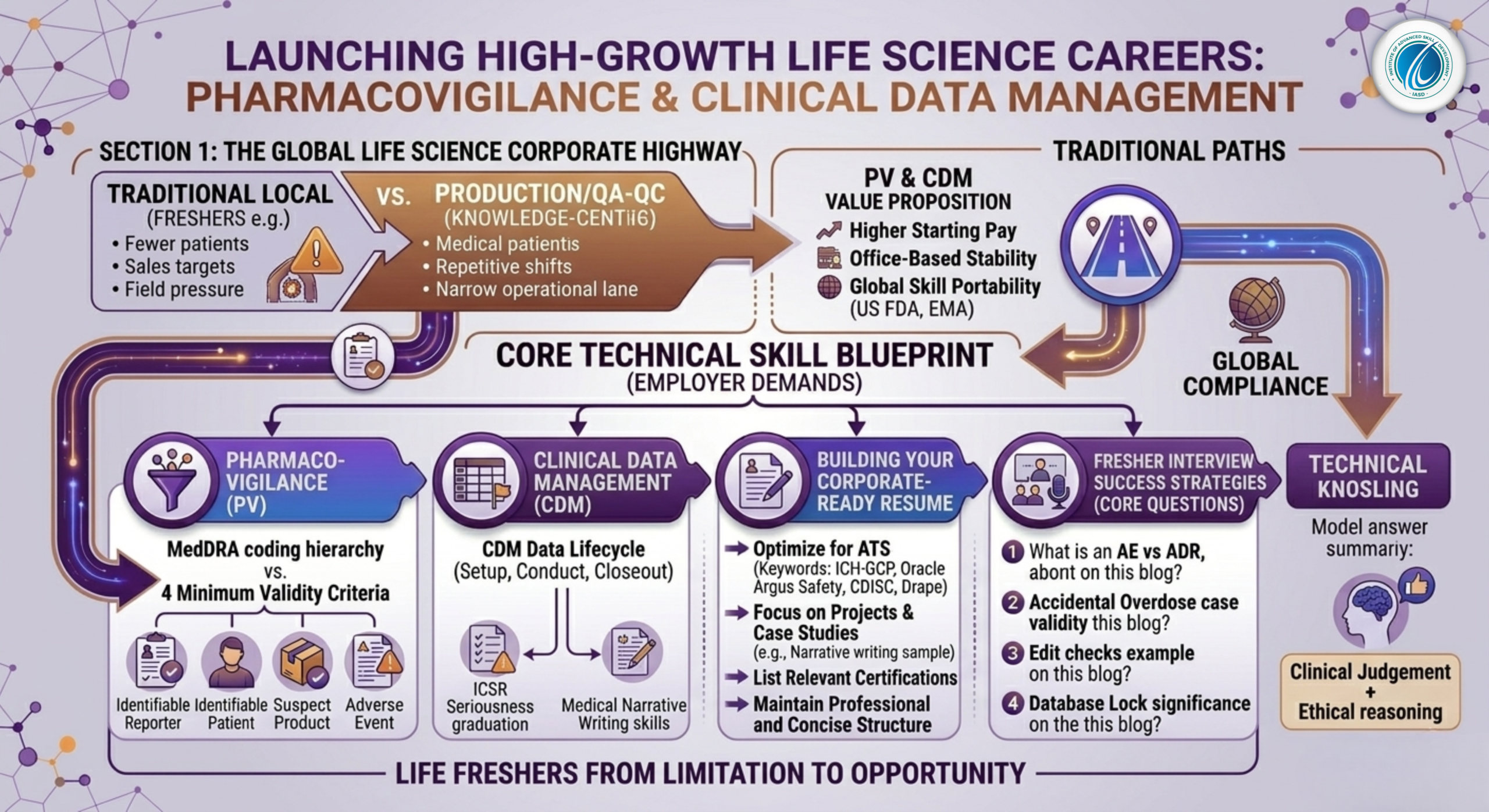
For thousands of life science and pharmacy graduates finishing their degrees across India, the transition from college lecture halls to the professional job market can feel overwhelming. Historically, students were pushed toward traditional, localized entry points: working as a Medical Representative (MR) facing high field sales targets, or entering manufacturing units to handle repetitive shifts in Production or basic QA/QC analytics.
While these paths are standard, they often come with limitations in long-term salary trajectory, global mobility, and fast-paced technological shifts.
Today, there is an alternative corporate highway. Driven by international outsourcing models and stringent global regulatory laws, India has become the premier engine for international Pharmacovigilance (PV) and Clinical Data Management (CDM) operations. These knowledge-centric domains offer clean corporate environments, high starting packages, and transferable skills recognized anywhere in the world.
This comprehensive guide serves as your step-by-step career blueprint to mastering the required skills, building a corporate-ready resume, and clearing your entry-level interviews at top multinational organizations.
1. Deconstructing the Corporate Value Proposition: Why PV and CDM?
Before spending time on interview preparation, you must understand why drug safety and data management represent a smarter career choice for life science graduates compared to traditional fields:
1.1 Financial Advantages and Growth Rates
-
Traditional Factory/Field Roles: Entry-level positions in production or medical sales often start at a modest baseline of ₹15,000 to ₹20,000 per month, with slow salary growth.
-
PV and CDM Corporate Tracks: Freshers joining reputable multinational pharmaceutical companies or global Contract Research Organizations (CROs) typically secure competitive starting packages of ₹3 to ₹4 Lakhs Per Annum (LPA). As technical expertise scales over a 3-to-5 year window, skilled safety professionals routinely command packages ranging from ₹6 to ₹10 LPA, with managers earning significantly higher.
1.2 Office-Based Stability and Global Skill Portability
Unlike manufacturing roles that require rotating night shifts or sales positions with high targets, PV and CDM are structured, office-based corporate positions. Furthermore, because drug safety operations and clinical trial datasets are governed by uniform international standards (such as US FDA and EMA laws), the experience you gain inside an Indian operational hub is directly portable to corporate networks in Europe, North America, and other regulated global markets.
2. Core Skill Frameworks Employers Demand
Because competition for entry-level trainee roles at top-tier companies is highly competitive, simply holding a degree is no longer enough to stand out. Employers look for candidates who demonstrate practical, day-one operational competencies.
                  ┌──────────────────────────────────────────────┐
                  │    HIGH-COMPETENCY CORPORATE GRADUATE        │
                  └──────────────────────┬───────────────────────┘
                                         │
       ┌─────────────────────────────────┼────────────────────────────────┐
       ▼                                 ▼                                ▼
┌──────────────┐                 ┌──────────────┐                 ┌──────────────┐
│  PV DOMAIN   │                 │  CDM DOMAIN  │                 │  SOFT SKILLS │
│ • MedDRA PTs │                 │ • CDISC/CDASH│                 │ • Corporate  │
│ • ICSR Triage│                 │ • EDC Systems│                 │   Writing    │
│ • Narrative  │                 │ • Query Life-│                 │ • Clinical   │
│   Writing    │                 │   cycle      │                 │   Reasoning  │
└──────────────┘                 └──────────────┘                 └──────────────┘
2.1 The Technical Toolkit for Pharmacovigilance Roles
If you are targeting a position as a Drug Safety Associate, you should focus on mastering these foundational concepts:
-
The Four Minimum Validity Criteria: The ability to instantly verify if a source report contains an identifiable reporter, an identifiable patient, a suspect product, and an adverse event.
-
MedDRA Hierarchy Architecture: Understanding the structural flow from Lowest Level Terms (LLTs) up to broad System Organ Classes (SOCs) to map real-world patient descriptions accurately.
-
Case Seriousness Graduation: Mastering the exact regulatory criteria used to classify an adverse event as serious (e.g., life-threatening, hospitalization, disability, or medically important).
-
Scientific Narrative Writing: Developing the ability to synthesize unstructured patient charts into clear, chronological, and grammatically precise medical biographies.
2.2 The Technical Toolkit for Clinical Data Management Roles
If your interests lean toward a career as a Clinical Data Manager, focus your training on these core phases:
-
The CDM Data Lifecycle: Understanding the end-to-end journey of a clinical trial dataset from initial setup and database design to study conduct and final database locking.
-
Interoperability Frameworks: Familiarity with the structural standards set by CDISC (SDTM/CDASH) and modern HL7 FHIR protocols for clean data exchange.
-
Query Lifecycle Management: Mastering how data discrepancies trigger automated or manual queries, and how data managers collaborate with clinical sites to resolve errors.
-
Medical Coding Dictionaries: Understanding how to use both MedDRA (for adverse events) and WHODrug Global (for concomitant medications) to keep datasets clean and consistent.
3. Designing an High-Impact Corporate Resume
Your resume is your personal brand statement; it is the very first interface an internal human resources team or an automated applicant tracking system (ATS) interacts with. Avoid generic, multi-page academic CVs and structure your resume with a sharp, professional focus.
3.1 Optimize for Applicant Tracking Systems (ATS)
Many multinational companies use automated software filters to screen hundreds of incoming resumes. To pass these automated gates, your resume must include specific industry keywords embedded naturally within your text. Ensure phrases like Individual Case Safety Reports (ICSR), MedDRA Coding, Data Integrity, ICH-GCP Guidelines, Edit Check Validation, and Oracle Argus Safety are clearly visible in your skills section.
3.2 Focus on Project and Practical Competencies
Instead of simply listing your college theory modules, write about any practical projects, industry-standard training certificates, case studies, or mock narrative processing work you performed during your preparation. Proving you have hands-on experience with user interfaces or global coding schemas instantly makes you more employable than a candidate with only textbook knowledge.
4. Cracking the Freshers Interview: Top Questions Decoded
To help you walk into your interview room with absolute confidence, here are the core technical questions frequently used by corporate panel reviewers to evaluate entry-level candidates, along with optimized answer strategies:
Question 1: “What is the difference between an Adverse Event (AE) and an Adverse Drug Reaction (ADR)?”
-
The Strategy: Interviewers use this question to check your core understanding of clinical safety. Focus on causation.
-
The Model Answer: “An Adverse Event is any untoward medical occurrence in a patient administered a medicinal product, and it does not necessarily have a causal relationship with the treatment. An Adverse Drug Reaction, however, requires at least a reasonable baseline probability of a causal relationship between the suspect drug and the experienced medical event.”
Question 2: “If a patient experiencing an adverse event takes an accidental overdose of a suspect drug, is the case still valid for processing?”
-
The Strategy: This tests your understanding of special situations in pharmacovigilance.
-
The Model Answer: “Yes, the case remains valid. Under international regulatory guidelines, instances of medication errors, accidental or intentional overdoses, drug misuse, and abuse must be fully captured and processed within the safety database, even if the primary event was driven by incorrect dosing administration.”
Question 3: “What is an edit check in Clinical Data Management, and can you provide an example?”
-
The Strategy: This checks your understanding of database validation mechanics in CDM.
-
The Model Answer: “An edit check is an automated validation script coded directly into an Electronic Data Capture (EDC) system. Its purpose is to check entered data against logical rules in real-time. For example, if a data entry user inputs a patient’s pulse rate as 600 beats per minute, or logs a visit date that occurs before the informed consent date, the edit check will instantly flag a discrepancy message, forcing the user to correct or verify the data point.”
Question 4: “What is the significance of a Database Lock, and what must happen before it is executed?”
-
The Strategy: This evaluates your knowledge of the trial closeout phase.
-
The Model Answer: “A database lock is the final step in the CDM lifecycle, permanently freezing the dataset into a read-only state to ensure data integrity prior to statistical analysis. Before execution, the data management team must verify that all data queries are resolved and closed, all external laboratory datasets are reconciled, all medical coding via MedDRA and WHODrug is complete, and a formal Blind Review has been signed off by stakeholders.”
5. The Road Ahead: Choosing Employability
India has established itself as the undisputed capital for global drug safety operations and clinical data hub networks. The jobs are out there, but they demand a fundamental shift away from rote learning and toward practical, operational competency.
By taking control of your training, mastering safety database logic, understanding international coding languages, and practicing structured medical writing, you can confidently step onto this high-growth highway—securing a rewarding corporate career that contributes directly to patient health worldwide.