Introduction
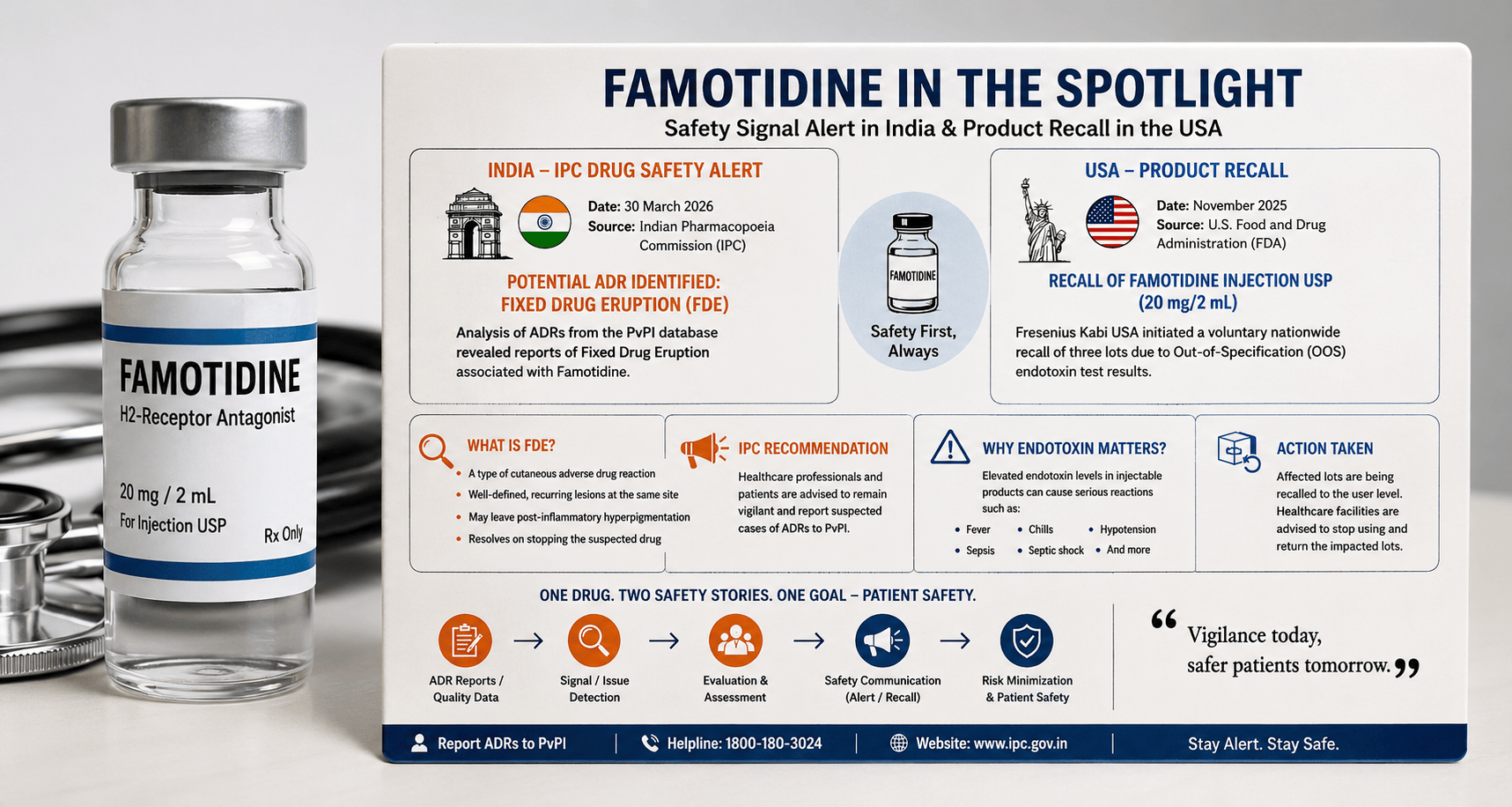
Pharmacovigilance is often associated with monitoring adverse drug reactions (ADRs). However, ensuring patient safety extends beyond ADR reporting. Drug quality issues, manufacturing deviations, and product recalls are equally important components of a robust pharmacovigilance system.
Recent developments involving Famotidine, a widely used acid-suppressing medication, provide an excellent example of how different safety systems work together to protect patients. While India identified a potential adverse drug reaction signal associated with Famotidine, the United States witnessed a product recall due to quality concerns. Although these events originated from different sources, both shared the same objective—patient safety.
What is Famotidine?
Famotidine belongs to the Histamine-2 Receptor Antagonist (H2RA) class of medicines. It reduces gastric acid secretion by blocking H2 receptors in the stomach.
Common Clinical uses
Famotidine is widely used in the management of several acid-related gastrointestinal conditions. It is commonly prescribed for Gastroesophageal Reflux Disease (GERD) to relieve symptoms of acid reflux, gastric and duodenal ulcers to promote healing, and Zollinger-Ellison syndrome to control excessive acid secretion. In hospital settings, it may also be used for stress ulcer prophylaxis, while its acid-suppressing effects make it useful in various other acid-related gastrointestinal disorders.
Due to its widespread use in both outpatient and hospital settings, continuous monitoring of its safety profile is essential.
India: Safety Signal Alert for Fixed Drug Eruption
In March 2026, the Indian Pharmacopoeia Commission (IPC), through the Pharmacovigilance Programme of India (PvPI), highlighted Fixed Drug Eruption (FDE) as a potential safety signal associated with Famotidine.
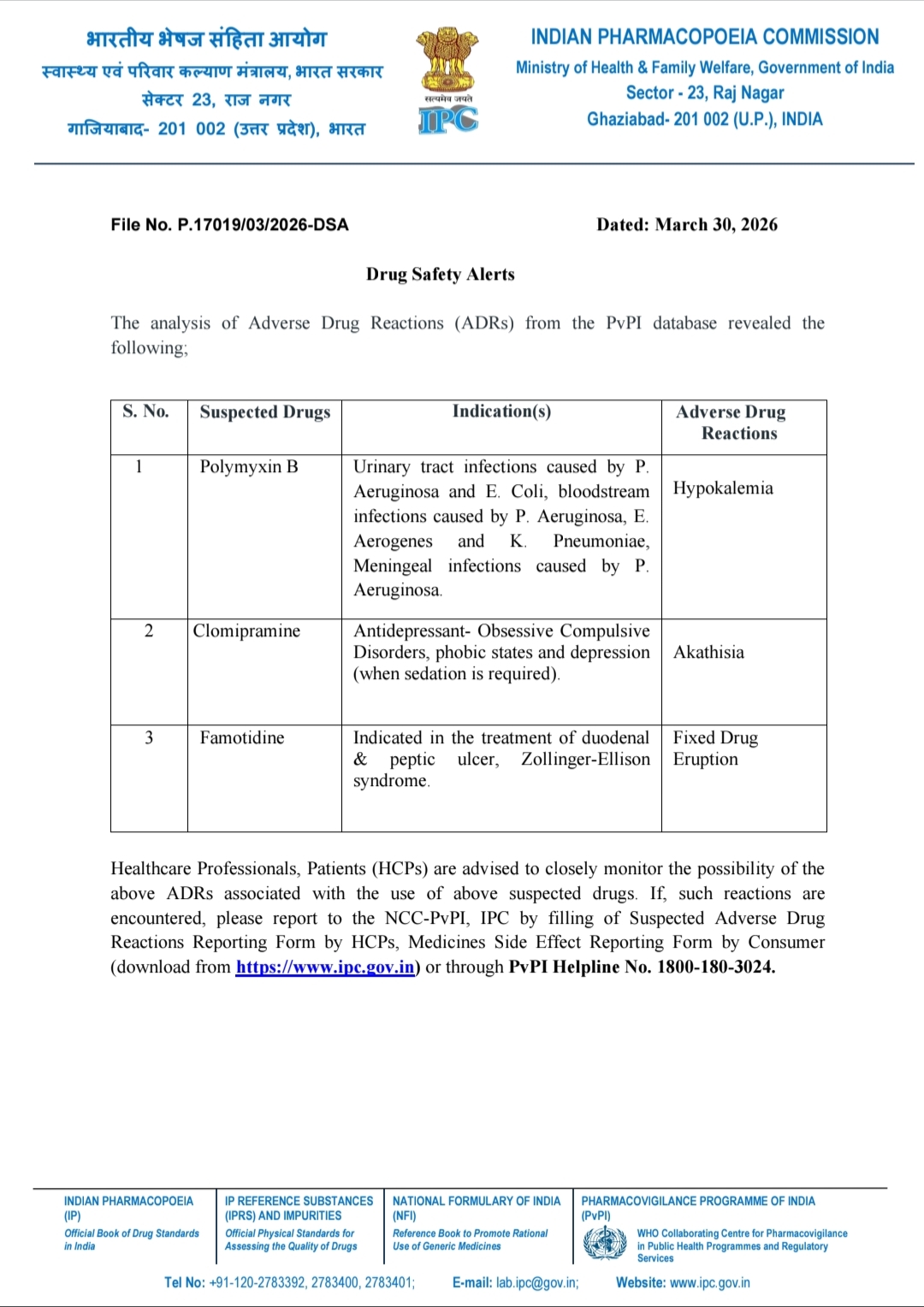
The signal emerged following the evaluation of ADR reports submitted to the PvPI database. Signal detection activities aim to identify new or changing safety information that may warrant further investigation.
Understanding Fixed Drug Eruption (FDE)
Fixed Drug Eruption (FDE) is a type of cutaneous adverse drug reaction characterized by the development of well-defined skin lesions that typically recur at the same anatomical site when a patient is re-exposed to the suspected medication. Following resolution, the affected area may show residual hyperpigmentation, which can persist for some time. In most cases, symptoms improve after withdrawal of the offending drug, making early recognition and appropriate management important for patient safety.
Although FDE is generally not life-threatening, recognition and timely reporting are important for patient management and ongoing safety assessment.
Why Signal Detection Matters
Signal detection serves as an early warning system in pharmacovigilance. It helps identify potential safety concerns before they become widespread clinical problems.
Healthcare professionals play a vital role in strengthening pharmacovigilance systems. By recognizing suspected adverse drug reactions (ADRs), accurately documenting clinical information, and reporting events to national pharmacovigilance centers, they contribute valuable data for safety monitoring. Their reports support signal detection, regulatory evaluation, and evidence-based decision-making, ultimately helping to improve patient safety and the safe use of medicines.
United States: Recall of Famotidine Injection USP
In a separate safety-related event, Fresenius Kabi USA initiated a voluntary nationwide recall of specific lots of Famotidine Injection USP (20 mg/2 mL).
The recall was triggered by Out-of-Specification (OOS) endotoxin test results, representing a product quality issue rather than an ADR signal.
What Are Endotoxins?
Endotoxins are toxic substances derived from the outer membrane of certain bacteria. If present in injectable products above acceptable limits, they may lead to serious clinical consequences.
Exposure to endotoxins can trigger a range of inflammatory responses in patients. Depending on the level of exposure and the patient’s clinical condition, reactions may range from fever and chills to more serious complications such as hypotension, sepsis-like reactions, and, in severe cases, septic shock. These potential risks underscore the importance of stringent quality control measures and endotoxin testing for injectable medications.
Because injectable medications bypass many natural defense barriers, strict endotoxin control is essential during manufacturing and quality testing.
Importance of Product Recalls
A product recall is a proactive risk minimization measure designed to prevent patient exposure to potentially compromised products.
Recalls demonstrate that pharmacovigilance and quality assurance systems are interconnected. Even when no patient harm has been reported, corrective action may be necessary to mitigate potential risks.
One Medicine, Two Safety Stories
The Famotidine case highlights two distinct but complementary approaches to patient protection:
| Safety Event | Source | Objective |
|---|---|---|
| Fixed Drug Eruption Signal | ADR Monitoring System | Identify potential adverse effects |
| Injection Recall | Quality Surveillance System | Prevent exposure to defective products |
Both pathways contribute to the same pharmacovigilance lifecycle:
Data Collection → Signal Detection → Assessment → Safety Communication → Risk Minimization → Patient Protection
Key Learning for Pharmacovigilance Professionals
For students and professionals entering pharmacovigilance, this example demonstrates that drug safety encompasses far more than case processing and ADR reporting.
Modern pharmacovigilance is a multidisciplinary field that extends far beyond ADR reporting. It involves signal management to identify emerging safety concerns, benefit-risk evaluation to assess whether a medicine’s therapeutic benefits continue to outweigh its risks, and safety communication to ensure that healthcare professionals and patients receive important safety information. It also includes product quality surveillance, risk minimization activities, and regulatory decision-making, all of which contribute to maintaining the safety and effectiveness of medicines throughout their lifecycle.
Understanding the relationship between safety signals and quality-related recalls is essential for developing a comprehensive view of patient safety.
Conclusion
The recent Famotidine safety developments remind us that pharmacovigilance is a multidisciplinary effort. Whether identifying a potential adverse drug reaction through spontaneous reports or removing a product from the market due to quality concerns, every action aims to protect patients.
The ultimate goal remains unchanged: ensuring that medicines are not only effective but also safe and of acceptable quality throughout their lifecycle.
Stay vigilant today for safer patients tomorrow.