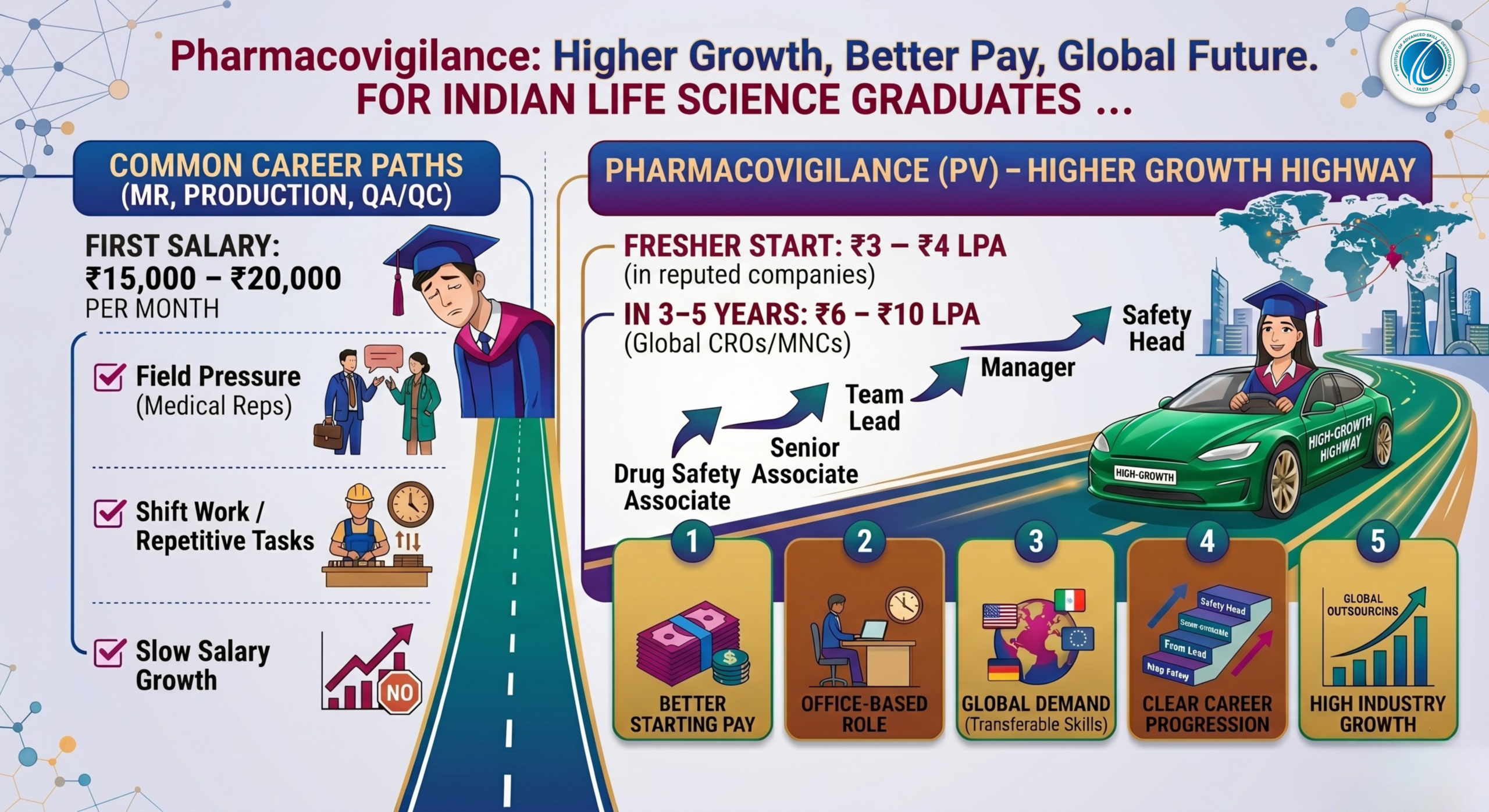
For many life science and pharmacy graduates in India, entering the workforce through traditional channels often means accepting roles in medical representation, manufacturing production, or baseline Quality Assurance and Quality Control (QA/QC). While these positions offer an immediate entry point into the pharmaceutical sector, they frequently present long-term structural challenges that can hinder professional satisfaction and financial independence.
Understanding the stark contrast between these legacy paths and specialized corporate alternatives is essential for building a stable, high-value career in the modern healthcare ecosystem.
1. The Reality of Traditional Entry-Level Roles
The initial career phase for a standard graduate in a production or sales environment is often characterized by high operational demands and conservative compensation structures:
-
Compensation Baseline: Initial salaries for medical representatives, production trainees, or QA/QC analysts typically fall within the range of ₹15,000 to ₹20,000 per month.
-
Field and Operational Pressure: Medical representation requires meeting intense daily field sales targets and navigating unpredictable physician schedules.
-
Rigid Working Conditions: Production and laboratory QA/QC roles frequently require rotating shift work, repetitive technical tasks, and prolonged exposure to manufacturing environments.
-
Stagnant Increments: Because these traditional sectors face talent saturation, vertical salary growth and promotion cycles can be exceptionally slow.
2. The Pharmacovigilance Alternative: Financial and Operational Trajectories
Pharmacovigilance (PV)—the systematic science of monitoring, assessing, and preventing adverse drug reactions—operates on an entirely different corporate framework. Because drug safety data management requires precise clinical analysis, the financial benchmarks reflect the high-value nature of the work.
-
Fresher Starting Packages: Entry-level professionals joining reputed drug safety organizations typically command starting packages between ₹3 Lakhs and ₹4 Lakhs Per Annum (LPA).
-
Mid-Term Financial Scaling: As analytical expertise and case-processing speeds develop, specialized professionals experience rapid salary increments, routinely reaching ₹6 Lakhs to ₹10 Lakhs LPA within 3 to 5 years.
-
MNC and CRO Premium: Professionals aligned with major multinational corporations (MNCs) or global Contract Research Organizations (CROs) frequently command packages that exceed standard domestic benchmarks.
3. Five Structural Reasons to Choose Pharmacovigilance
Compared to traditional pharmaceutical jobs, pharmacovigilance offers a superior working environment and clear professional advantages:
Higher Starting Compensation
The baseline entry-level package in drug safety sits significantly higher than the cumulative annual earnings of standard field sales or entry-level manufacturing roles.
Corporate Office Environment
Pharmacovigilance is a professional, desk-based corporate function. It eliminates the physical fatigue of field sales targets and the erratic sleep patterns associated with factory floor rotating shifts.
Transferable Global Demand
The guidelines governing drug safety—such as ICH-GCP, MedDRA coding systems, and FDA/EMA compliance metrics—are standardized globally. The skills you build in India are directly transferable to international markets like the United States and the European Union.
Defined Corporate Progression
The hierarchy within corporate pharmacovigilance is structured and transparent, offering a clear upward trajectory:
-
Drug Safety Associate
-
Senior Drug Safety Associate
-
Team Lead
-
Project Manager / Operations Manager
-
Safety Head
Macro-Economic Growth Drivers
India has fully established itself as a premier destination for global knowledge process outsourcing (KPO). As international pharma giants continue to outsource their massive clinical safety pipelines to Indian hubs, the sector experiences sustained, long-term expansion.
4. Strategic Career Conclusion
While legacy pharmaceutical roles can confine a graduate to a rigid, slow-moving career lane, specializing in pharmacovigilance places you on a high-growth career highway. For graduates seeking long-term stability, competitive corporate compensation, and international exposure, transitioning into drug safety represents a highly strategic career pivot.