Pharmacovigilance (PV) has emerged as one of the fastest-growing and most rewarding career paths in India’s life science sector. Driven by an influx of global clinical trials, massive regulatory outsourcing, and heightened international scrutiny, India has firmly established itself as a premier global hub for drug safety operations.
Yet, a glaring paradox remains: despite an exponential rise in corporate demand for drug safety talent, the vast majority of universities across India completely fail to prepare their life science and pharmacy students for a career in PV.
Understanding the Gap Between Industry and Academia
The disconnect between university lecture halls and the corporate life science environment boils down to four critical factors:
1. Outdated and Rigid Curriculums
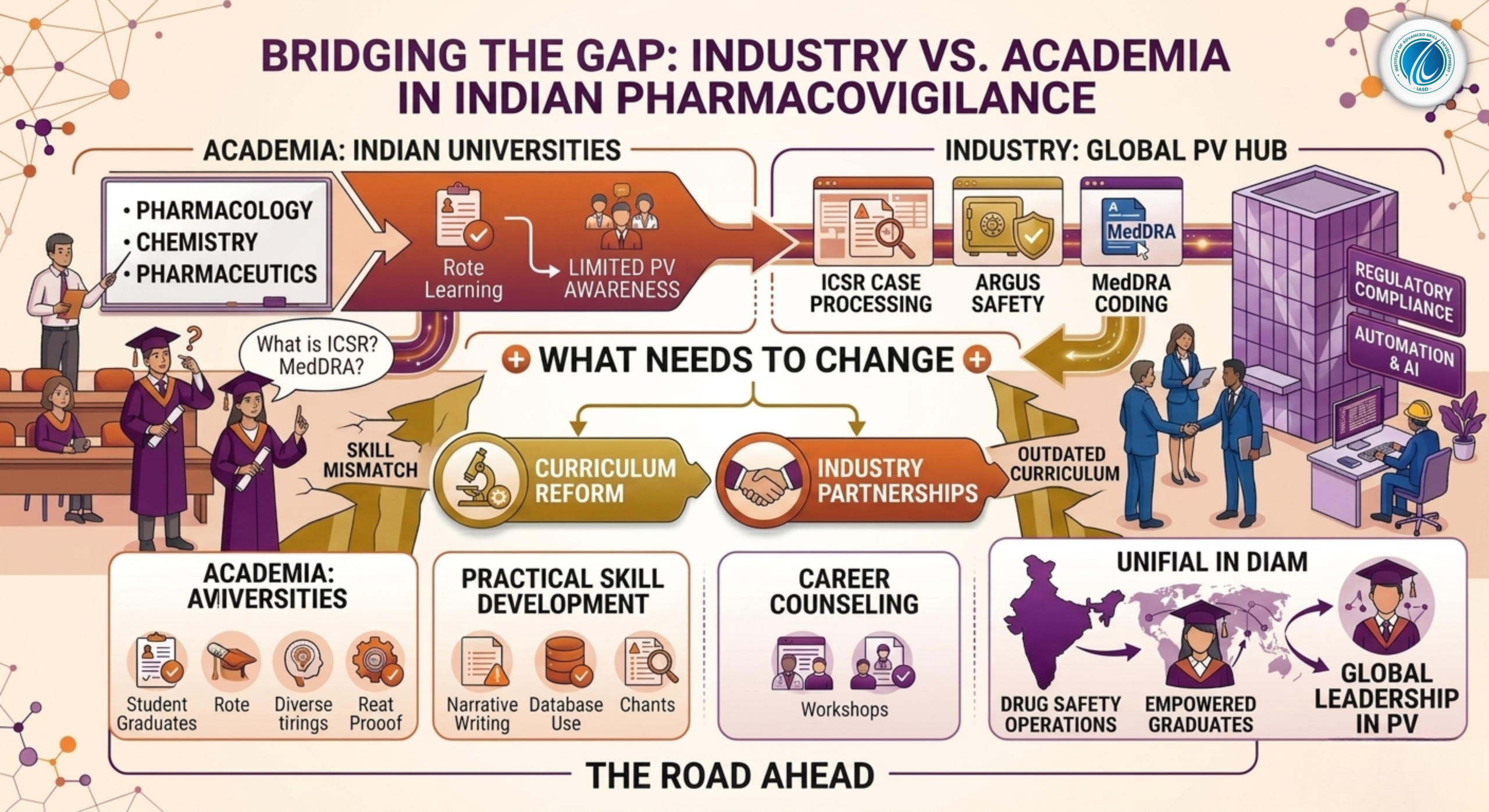
While traditional pharmacy and life science programs heavily emphasize core sciences like pharmacology, pharmaceutics, and medicinal chemistry, they fundamentally ignore the operational realities of drug safety. Crucial, industry-standard domains—such as Individual Case Safety Report (ICSR) processing, MedDRA coding, safety databases (like Oracle Argus Safety), and global regulatory compliance frameworks—are completely absent from the syllabus.
2. Lack of Practical Industry Integration
Unlike academic ecosystems in Europe or North America, Indian colleges rarely establish deep institutional collaborations with pharmaceutical companies or Contract Research Organizations (CROs). Without mandatory industry internships, hands-on workshops, or direct exposure to live drug safety databases, students graduate with theoretical knowledge but zero day-one employability.
3. A Widening Skill Gap in Compliance and Technology
The modern pharmacovigilance landscape is moving rapidly toward cloud-based digital infrastructure, automated workflows, and artificial intelligence integration. Because academic institutions fail to keep pace with these corporate technological transformations, graduates face an immediate skill gap when entering the competitive job market.
4. Limited Career Awareness Among Students
A staggering number of students remain unaware that drug safety even exists as a viable career option until very late in their degrees. This lack of early guidance creates a massive skill mismatch, forcing graduates to seek specialized, post-graduate professional certification courses just to clear entry-level corporate interviews.
The Solution: What Needs to Change?
To transform India’s massive graduate pool into an industry-ready workforce, the higher education ecosystem must urgently implement four core reforms:
-
Comprehensive Curriculum Reform: Integrate structural modules on pharmacovigilance, drug regulatory affairs (DRA), and clinical data management (CDM) directly into core undergraduate and postgraduate syllabi.
-
Strategic Industry Partnerships: Build formal pipelines with global CROs, multinational pharmaceutical corporations, and regulatory experts to facilitate specialized guest lectures, live corporate training modules, and structured internships.
-
Practical Skill Development: Shift the educational focus away from rote memorization and toward practical, operational competencies—including standard MedDRA mapping, medical narrative writing, data entry validation, and compliance tracking.
-
Early Career Counseling: Launch aggressive awareness drives, interactive workshops, and life science seminars early in the academic lifecycle so students can actively choose their career trajectories.
The Road Ahead
India possesses an unparalleled pool of ambitious life science talent and a globally recognized pharmaceutical infrastructure. However, moving forward requires a fundamental mindset shift within Indian academia—one where post-graduate employability and real-world corporate relevance take absolute center stage.
Bridging this critical educational gap will not only empower lakhs of young graduates with high-paying corporate careers but will also secure India’s position as an undisputed powerhouse in the global drug safety ecosystem.