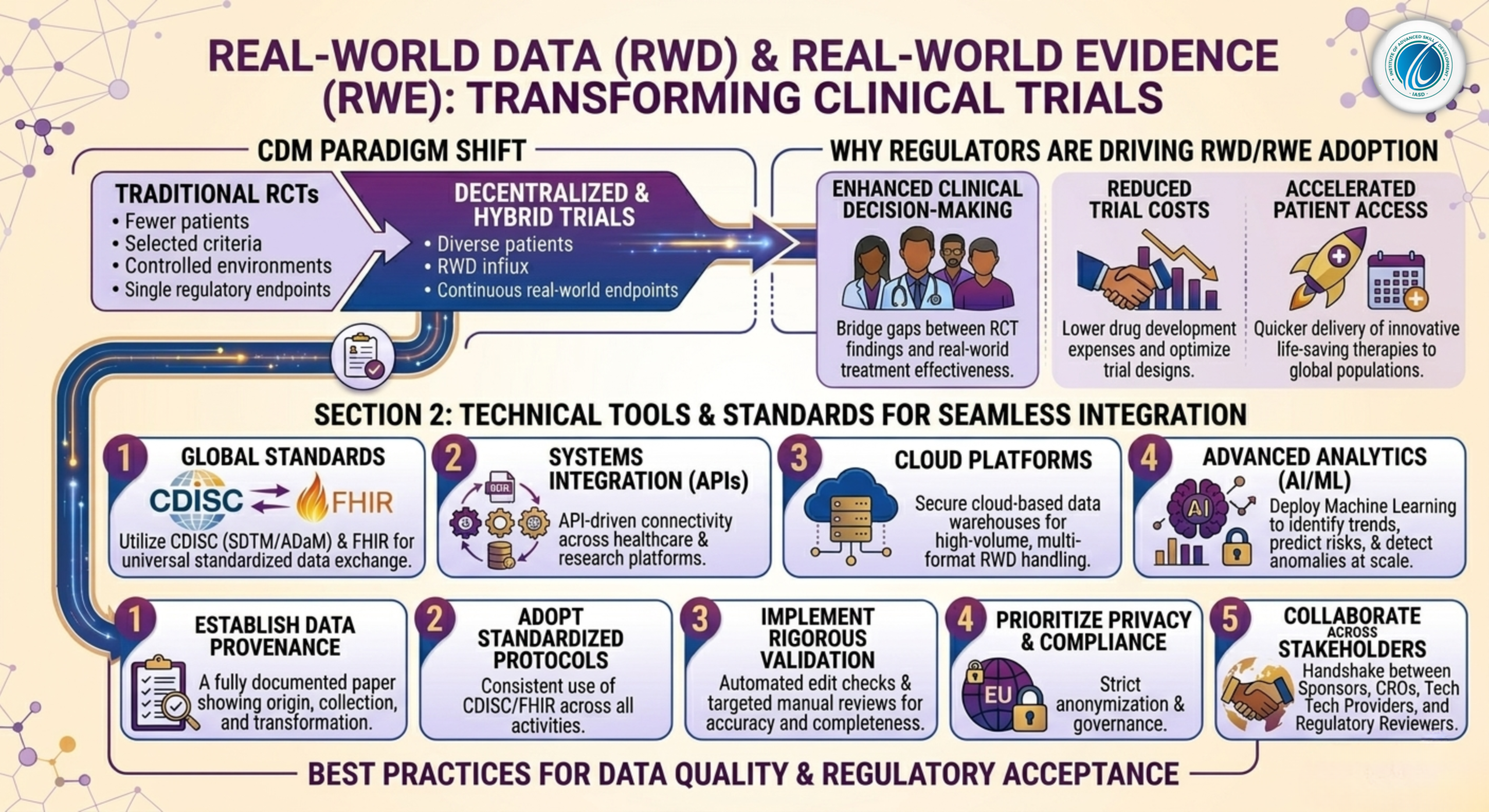
In recent years, Real-World Data (RWD) and Real-World Evidence (RWE) have rapidly transitioned from industry buzzwords into core components of modern clinical research. Global regulatory bodies, such as the United States Food and Drug Administration (US FDA) and the European Medicines Agency (EMA), are increasingly advocating for the utilization of RWD and RWE to support drug development pipelines, post-market safety monitoring, and formal regulatory decision-making.
This monumental shift signals a new era for Clinical Data Management (CDM)—one that demands advanced system integration, robust data standards, and stringent governance practices.
1. Why Regulators are Driving RWD Adoption
The traditional clinical trial model is highly rigorous but inherently limited in scope. Standard randomized controlled trials (RCTs) evaluate therapies within tightly controlled environments using carefully selected, homogeneous patient populations. While this design ensures internal scientific validity, it creates significant gaps in understanding how a treatment actually performs across diverse, real-world patient populations with complex comorbidities and varied lifestyles.
To bridge this gap, health authorities are expanding their frameworks:
-
The US FDA’s 21st Century Cures Act: Heavily emphasizes the use of RWE to support the approval of new indications for existing drugs and to satisfy post-market surveillance commitments.
-
The EMA Framework: Actively encourages the integration of RWD to continuously monitor long-term safety profiles, rare adverse drug reactions, and real-world treatment effectiveness across broader populations.
Ultimately, regulators view RWD as a powerful tool to enhance clinical decision-making, optimize trial design, lower drug development costs, and accelerate patient access to innovative life-saving therapies.
2. Technical Tools and Standards for Seamless Integration
Successfully integrating RWD into the clinical trial workflow requires absolute interoperability between disparate healthcare networks and clinical trial databases. CDM professionals rely on a specialized stack of tools and data architectures to achieve this:
2.1 HL7 FHIR (Fast Healthcare Interoperability Resources)
FHIR acts as the universal translator, supporting the efficient, standardized exchange of digital health records across Electronic Health Records (EHRs), hospital laboratory systems, and electronic data capture (EDC) platforms.
2.2 CDISC Standards (SDTM and ADaM)
The Study Data Tabulation Model (SDTM) and Analysis Data Model (ADaM) provide the mandatory structural foundation for data formatting. Enforcing these standards ensures that messy real-world data is organized into consistent, traceable, and compliant datasets ready for regulatory review.
2.3 APIs and Cloud Platforms
Application Programming Interfaces (APIs) paired with secure cloud infrastructure enable the real-time or near-real-time ingestion of RWD streams into active trial workflows, supporting faster medical monitoring and proactive safety decisions.
2.4 Advanced AI and Analytics Tools
Applying Artificial Intelligence (AI) and Machine Learning (ML) algorithms allows data managers to screen massive, unstructured real-world datasets to identify emerging safety trends, perform predictive risk analytics, and detect anomalies at scale.
3. Best Practices for Data Quality and Regulatory Acceptance
Incorporating data collected outside of a traditional trial site requires strict data governance to ensure it is auditable and trustworthy. Implementing the following industry best practices is crucial:
-
Establish Clear Data Provenance: Every data point must have a fully documented paper trail detailing its exact origin, original collection method, and any subsequent digital transformations.
-
Enforce Uniform Data Standards: Consistently utilize CDISC and FHIR frameworks across all data capture, cleaning, and integration phases to maintain structural uniformity.
-
Implement Rigorous Data Validation: Deploy a hybrid validation strategy combining automated database edit checks with targeted manual reviews to guarantee absolute data accuracy, completeness, and chronological consistency.
-
Prioritize Privacy and Legal Compliance: Align all data processing workflows with stringent international data privacy mandates, including HIPAA, GDPR, and emerging regulatory structures such as the European Health Data Space (EHDS).
-
Foster Cross-Stakeholder Collaboration: Establish early, proactive dialogues between study sponsors, Contract Research Organizations (CROs), technology vendors, and regulatory reviewers to ensure complete alignment on data endpoints before the study begins.
4. The Road Ahead for CDM Professionals
The integration of RWD and RWE is far more than a simple software upgrade; it represents a fundamental paradigm shift in how clinical trials are designed, executed, and evaluated. Over the next few years, this data evolution will form the bedrock of decentralized clinical trials (DCTs) and hybrid research models, directly improving trial diversity, patient recruitment, and real-world clinical relevance.
For Clinical Data Management professionals, this evolution brings an exciting mix of challenges and opportunities. Achieving corporate success on this high-growth highway will depend on upskilling in big data tools, adhering strictly to global interoperability standards, and building ironclad strategies for data quality and compliance.