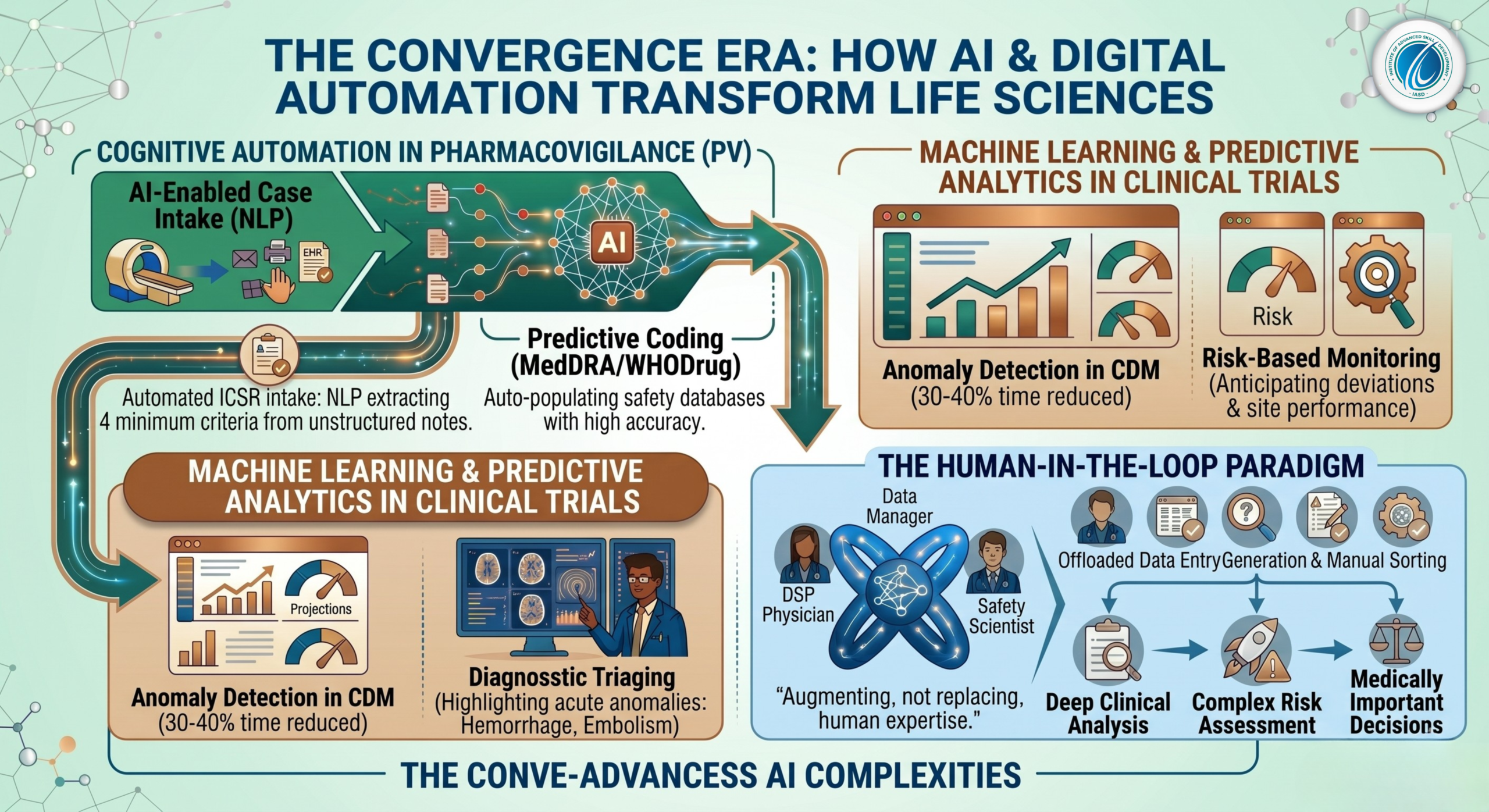
The global life sciences, healthcare, and pharmaceutical sectors are experiencing an unprecedented data revolution. Historically, clinical research and drug safety monitoring relied almost entirely on manual human review. However, the modern explosion of health data—driven by high-throughput genomics, real-world data streams, global electronic health records (EHRs), and wearable biosensors—has pushed traditional workflows past their practical limits.
Today, pharmaceutical organizations and clinical trial sponsors are turning to Artificial Intelligence (AI), Machine Learning (ML), and Natural Language Processing (NLP). Far from being experimental add-ons, these digital technologies are driving a profound shift in how drugs are evaluated, monitored, and kept safe for public use.
1. Automated Intake and Cognitive Automation in Pharmacovigilance
The most acute operational bottleneck in modern drug safety is the massive volume of incoming Individual Case Safety Reports (ICSRs). During global public health events or widespread seasonal illnesses, a multinational pharmaceutical company can receive tens of thousands of safety complaints every week. Manually reading, triaging, and processing these cases leads to significant backlogs.
1.1 Natural Language Processing (NLP) for Free-Text Extraction
Advanced Natural Language Processing (NLP) algorithms are fundamentally changing the data entry phase. When a raw medical complaint arrives—whether as a handwritten physician note, an unstructured hospital discharge text, or an email conversation—the NLP model scans the document to identify key medical contexts.
[Raw Unstructured Physician Note]
            │
            ▼ (Natural Language Processing Engine)
┌───────────────────────────────────────────────┐
│ • Identifiable Patient: "54yo Male"           │
│ • Suspect Drug: "Drug X"                      │
│ • Adverse Event: "Acute Myocardial Infarction"│
│ • Identifiable Reporter: "Dr. Smith"          │
└───────────────────────────────────────────────┘
            │
            ▼ (Auto-Populated Fields)
[Oracle Argus Safety Database]
The AI reads the narrative text, automatically extracts the four minimum case validity criteria, and populates the matching field slots inside safety databases like Oracle Argus.
1.2 Automated MedDRA Predictive Coding
Assigning exact MedDRA codes to patient descriptions requires significant time and training. Machine learning models, trained on millions of historical historical cases, can analyze unstructured terms and instantly predict the correct MedDRA Preferred Term (PT) with over 95% accuracy.
The AI presents its highest-probability match to a human safety associate, transforming a manual search process into a rapid, one-click verification step.
2. Machine Learning and Predictive Analytics in Clinical Trials
Clinical Data Management (CDM) and trial execution have traditionally been reactive disciplines—waiting for data to arrive at a central database before cleaning it, and waiting for patient dropouts to happen before modifying recruitment strategies. Machine learning introduces a proactive, predictive layer to the trial lifecycle.
2.1 Automated Data Cleaning and Real-Time Anomaly Detection
In standard trials, identifying data inconsistencies can take weeks as records move through data management query loops. Machine learning algorithms embedded within cloud-based Electronic Data Capture (EDC) platforms track data entry patterns continuously.
The AI flags anomalies—such as a blood pressure value that deviates sharply from a patient’s historical baseline, or an improbable sequence of visit dates—the moment the site coordinator clicks save. This reduces total study data cleaning timelines by 30% to 40%.
2.2 Risk-Based Monitoring (RBM) and Predictive Analytics
Predictive algorithms can analyze historical performance metrics across hundreds of international hospital sites to forecast future compliance risks. If a specific clinical site shows patterns indicating an increased risk of protocol deviations, high patient dropout rates, or delayed data entry, the AI alerts the study sponsor.
This allows monitors to intervene proactively, optimizing site resources and ensuring data integrity before issues compromise the trial.
3. Computer Vision and Deep Learning in Medical Diagnostics
The impact of artificial intelligence extends directly into medical imaging and diagnostics, where deep learning algorithms help close critical gaps in expert medical access.
3.1 Convolutional Neural Networks (CNNs) in Medical Imaging
Convolutional Neural Networks (CNNs) excel at analyzing complex visual data. Trained on millions of validated clinical scans, these deep learning models can analyze X-rays, MRI scans, CT images, and dermatological photographs to flag abnormalities with remarkable precision.
[Raw MRI / X-Ray Scan] ➔ [Convolutional Neural Network (CNN) Filtering] ➔ [Anomaly Highlighted & Prioritized] ➔ [Immediate Radiologist Review]
3.2 High-Throughput Diagnostic Triaging
In high-volume hospital environments, wait times for specialist radiological reviews can extend for hours. AI diagnostic software acts as a triage engine, automatically screening incoming scans and instantly moving cases with high-probability anomalies (e.g., an acute intracranial hemorrhage or a pulmonary embolism) to the top of the radiologist’s queue, saving precious minutes when patient lives are on the line.
4. The Human-in-the-Loop Paradigm: Why Expertise Remains Essential
The rapid advancement of automation often sparks concerns that artificial intelligence will completely replace human professionals in the life science workforce. However, within highly regulated medical industries, the reality is entirely different: AI is designed to augment human expertise, not replace it.
The Life Science Automation Axiom: “Algorithms provide unprecedented speed and pattern recognition, but they lack clinical judgment, ethical reasoning, and medical accountability.”
┌───────────────────────────┐      ┌───────────────────────────┐
│     AI AUTOMATION ENGINE  │      │  HUMAN CLINICAL EXPERT    │
│  • Scales massive data    │ ───> │  • Medical validation     │
│  • Automates data entry   │      │  • Complex causality      │
│  • Flags hidden trends    │      │  • Strategic oversight    │
└───────────────────────────┘      └───────────────────────────┘
An artificial intelligence model can process an ICSR file in milliseconds or flag a diagnostic image anomaly instantly, but it cannot navigate nuanced clinical dilemmas. It cannot evaluate whether a complex, multi-system medical failure was driven by a drug interaction or a rare genetic mutation. It cannot author high-level global Risk Management Plans, and it cannot stand behind a regulatory data submission under audit.
The future belongs to the AI-augmented professional. By automating repetitive data entry tasks, validation checks, and manual sorting, AI frees up pharmacists, data managers, and drug safety associates to focus on what they do best: deep clinical analysis, comprehensive risk assessment, and strategic decision-making that keeps patients safe worldwide.